Cybersecurity Best Practices for South African Businesses: A Complete 2026 Guide
Published: 26 December 2025
Security
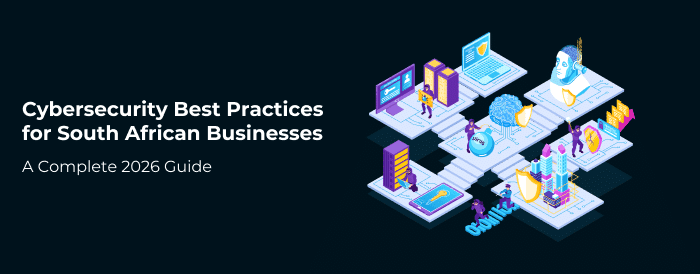
Cybersecurity is no longer just an IT concern or a “nice-to-have” control layered on top of business operations. In 2026, cybersecurity is fundamentally a software engineering and business resilience problem. especially for South African businesses that rely heavily on cloud platforms, web applications, APIs, and digital customer data.
From ransomware attacks and API abuse to cloud misconfigurations and compliance failures under POPIA, the threat landscape has evolved faster than most organisations’ security maturity. We provide trusted cybersecurity consulting services to help businesses navigate these challenges. This guide is designed to educate, explain, and raise awareness, while helping business and technology leaders understand what effective cybersecurity practices look like in real-world operations, not just in theory.
Whether you are a growing SME, a SaaS company, or an enterprise modernising your systems, these cybersecurity best practices will help you reduce risk, improve resilience, and make informed decisions in 2026 and beyond.
Jump To

Secure Your Business with Digital Humanity
Get expert guidance to protect your systems from Digital Humanity
Why Cybersecurity Must Be Engineering‑Led in 2026
Traditionally, cybersecurity was treated as a perimeter problem: firewalls, antivirus software, and network controls owned by IT teams. That model no longer reflects how breaches actually happen.
In South African organisations today, security incidents most commonly originate from:
- Compromised user identities
- Insecure application logic or APIs
- Cloud misconfigurations
- Unpatched systems and exposed services
- Third‑party and supply‑chain weaknesses
Because these failures occur inside the software stack, cybersecurity can no longer be bolted on after deployment. It must be designed into architecture, development workflows, and operational processes.
A strong cybersecurity posture in 2026 is the result of:
- Secure system design
- Disciplined development practices
- Continuous visibility and monitoring
- Clear business accountability
12 Core Cybersecurity Best Practices for South African Businesses
Cybersecurity in South Africa is now a business survival issue. With increasing ransomware attacks, stricter POPIA enforcement, and targeted fraud campaigns, surface‑level controls are no longer sufficient.
The most resilient organisations adopt a defence‑in‑depth approach, addressing people, processes, and technology together. The following 12 practices reflect what works in real South African environments.
1. Establish Cyber Risk Management as a Business Function
Effective cybersecurity starts at leadership level. Mature organisations treat cyber risk in the same way they treat financial, legal, or operational risk.
This begins with regular cyber risk assessments that identify and inventory:
- Business‑critical data
- Applications and APIs
- Cloud platforms and infrastructure
- End‑user devices
- Third‑party services and integrations
These assets must be ranked by business impact, not just technical importance. A customer database or payment API is more critical than an internal test system, regardless of where it is hosted.
Accountability is essential. This may take the form of a CISO, an Information Officer under POPIA, or a senior executive with decision‑making authority. When ownership is unclear, security becomes reactive and fragmented.
2. Lock Down Identity and Access Across All Systems
In the majority of South African breaches, attackers do not break in when they log in.
Stolen, reused, or phished credentials remain the most common attack vector. As a result, identity security is the single highest‑impact control most organisations can implement.
Best practice includes:
- Mandatory multi‑factor authentication (MFA) for email, cloud consoles, VPNs, admin panels, and financial systems
- Enforcing least‑privilege access so users only have the permissions they need
- Regular access reviews, especially for administrators and contractors
- Stronger controls for privileged and service accounts
If identity is weak, no amount of network or endpoint security will compensate.
3. Secure Endpoints for Hybrid and Remote Workforces
Every laptop and mobile device is now a potential entry point into the business.
Modern endpoint security goes beyond traditional antivirus. Devices should be:
- Centrally managed
- Fully patched and encrypted
- Continuously monitored for suspicious behaviour
- Protected against credential theft and malware
Local administrator privileges should be restricted, and lost or stolen devices must be remotely wipeable. When endpoint controls are implemented correctly, even successful phishing attempts are far less likely to escalate into full breaches.
4. Maintain Disciplined Patch and Vulnerability Management
Most cyber attacks exploit known vulnerabilities, not sophisticated zero‑day exploits.
Outdated operating systems, unpatched applications, exposed services, and forgotten firmware remain common weaknesses, particularly in fast‑growing South African businesses.
Effective vulnerability management requires:
- Asset visibility (you cannot patch what you do not know exists)
- Automated patching where possible
- Regular vulnerability scanning
- Clear remediation timelines based on risk
Patching is not glamorous, but it remains one of the most cost‑effective security controls available.
5. Secure Networks Through Segmentation and Intentional Design
Flat networks make attackers’ jobs easy. Once inside, they can move laterally with minimal resistance.
Network security best practice includes:
- Properly configured firewalls with minimal open ports
- Segmentation between critical systems, user networks, guest Wi‑Fi, and development environments
- Isolation of sensitive workloads in cloud and hybrid environments
Segmentation ensures that a single compromised device or account does not result in a full organisational breach.
6. Protect Business Data With Encrypted, Tested Backups
Ransomware operators increasingly target backups before encrypting production systems. If backups are compromised, recovery becomes extremely difficult.
Best practice requires:
- Encrypted backups
- Offline or logically isolated storage
- Strict access controls
- Regular restoration testing
Backups are not insurance policies. They are recovery mechanisms, and they must be treated as such.
Stay Ahead of Cyber Threats
Digital Humanity helps South African businesses embed cybersecurity into development
7. Secure Applications, APIs, and the Software Development Lifecycle
For many South African organisations, applications are the business.
Application security must be intentional and continuous. This includes:
- Secure authentication and session management
- Input validation and protection against common attacks
- Proper API authentication, authorisation, and rate limiting
- Monitoring third‑party libraries and dependencies for vulnerabilities
Security should also be embedded into the software development lifecycle (SDLC) through:
- Threat modelling during design
- Secure code reviews
- CI/CD pipeline protection and secrets management
- Logging and monitoring for abuse and misuse
When applications are insecure, attackers do not break systems — they simply use them in unintended ways.
8. Build Practical Cyber Awareness Across Your People
Human error remains a major contributing factor in security incidents, particularly phishing, social engineering, and business email compromise.
Effective awareness programmes are:
- Ongoing rather than once‑off
- Relevant to local South African scam patterns
- Focused on recognition and reporting, not blame
Employees should feel confident reporting suspicious activity quickly. Early reporting often prevents minor issues from becoming major incidents.
9. Prepare, Document, and Test an Incident Response Plan
No organisation plans to suffer a cyber incident, but unprepared organisations suffer the most damage.
An incident response plan should clearly define:
- What constitutes an incident
- Who makes decisions
- How systems are isolated and investigated
- How internal and external communication is handled
Under POPIA, organisations must notify the Information Regulator and affected individuals without unreasonable delay. Regular tabletop exercises ensure that response becomes structured rather than chaotic.
10. Transfer Residual Risk With Cyber Insurance
Cyber insurance does not replace good security, but it can reduce the financial and operational impact of incidents.
In South Africa, cyber insurance adoption is increasing, often providing access to forensic specialists, legal advisors, and crisis communication support. Insurers also require baseline security controls, indirectly improving overall maturity.
11. Secure Third‑Party and Supply‑Chain Relationships
Every vendor and service provider expands your attack surface.
Best practice includes:
- Assessing vendors before onboarding
- Limiting their access to only what is necessary
- Contractually enforcing breach notification and security obligations
POPIA makes it clear that vendor breaches can quickly become your responsibility. Trust is important, but verification is essential.
12. Commit to Continuous Improvement and Governance
Cybersecurity is not a once‑off project. It is an ongoing discipline.
Regular reviews, audits, and risk assessments help organisations adapt to new threats and technologies. Frameworks such as ISO 27001, NIST CSF, OWASP Top 10, and King IV governance principles provide useful maturity benchmarks.
When cybersecurity is discussed at board level, it becomes part of organisational culture — not just infrastructure.
Conclusion
In 2026, cybersecurity is no longer just an IT concern—it is a critical element of business resilience and software engineering excellence. South African organisations that adopt engineering-led practices across identity, endpoints, applications, APIs, and cloud infrastructure can reduce risk, maintain POPIA compliance, and strengthen operational continuity. Partnering with Digital Humanity’s cybersecurity consulting services ensures that critical systems are secured, performance is optimised, and security is embedded into the core of your technology strategy, supporting broader digital transformation goals.
Equally important is the human aspect. By working with Digital Humanity, organisations benefit from a human-centric approach where technology decisions reflect trust, transparency, and practical business value. Combining strong technical controls with a culture of awareness and accountability enables businesses to protect customer data, build trust, and demonstrate digital leadership, turning cybersecurity into a competitive advantage and a foundation for sustainable growth.
Related Blogs

Development
How to Build a Budgeting App in South Africa (Complete 2026 Guide)
South Africa is experiencing a rapid shift toward digital money management. Rising living costs, increasing household debt, and widespread mobile banking adoption have created strong demand for budgeting apps that help individuals and businesses manage their finances better.

DevelopmentStrategy
Low-Code vs. Custom Mobile App Development: What’s Best for South African Startups in 2026?
Low code mobile app development vs custom mobile app development is a question South African startups in 2026 are asking in one of the most competitive and cost-sensitive environments the country has ever seen. Funding is more selective, customers expect world-class digital experiences, and infrastructure realities like load shedding, data costs, and device diversity still shape how mobile apps are used.
Strategy
Best 6 Payment Gateways in South Africa: How to Choose and Integrate the Right One
If you’re searching for payment gateways in South Africa, you’re not here for theory. You want to know which options exist, how they actually work, and which one will perform best once integrated into your website, store, or app. South African payments aren’t simple, customers use cards, EFT, QR codes, and instalments, often on the same site.