Web Development vs Software Development: What Does Your South African Business Actually Need?
Published: 18 December 2025
Development
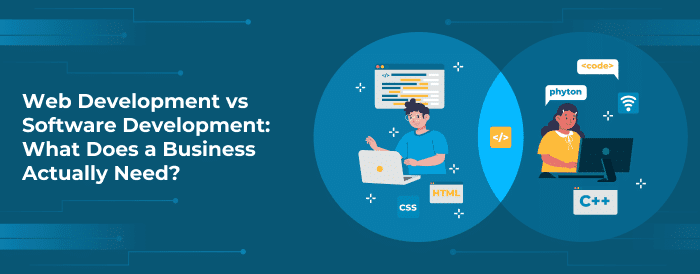
If you’re planning a digital project in South Africa, you’ve likely asked this question already:
“Do I need web development or software development?”
It’s a common point of confusion especially for business owners, founders, and operations managers who don’t live in the tech world every day. The terms are often used interchangeably, but choosing the wrong one can cost you time, money, and momentum.
In South Africa, where budgets are tighter and digital investments need to show clear ROI, making the right call from the start matters even more.
With years of experience as a leading software and web development company, we’ve created this guide to help you make the right decision. It explains the difference using real-world scenarios relevant to South African businesses, so you can choose confidently.
Jump To
- Quick Answer for Software Development Vs. Web Development
- Why This Decision Matters for South African Businesses
- Web Development vs Software Development: Side-by-Side Comparison
- Common Mistakes Businesses Make When Choosing Web or Software Development
- How to Choose the Right Development Partner
- Final Thoughts:
- FAQs About the Web Vs. Software Development

Unsure Whether to Choose Web or Software Development?
Get expert guidance to select the right approach for your South African business.
Quick Answer for Software Development Vs. Web Development
- Choose web development if you’re building a website, web app, customer portal, or SaaS product that runs in a browser.
- Choose software development if you need a custom system, internal automation, complex integrations, or a scalable business platform.
Still unsure? That’s normal. Most growing South African businesses actually use both over time. The key is knowing what to start with.
Why This Decision Matters for South African Businesses
South African businesses are investing more in digital solutions, yet many projects fail or stall because the wrong development approach is chosen at the start. Understanding the difference between web development and software development helps you make better decisions from day one.
Local realities:
Power constraints, distributed teams, and infrastructure limitations mean businesses need stable, efficient systems not over-engineered solutions.
Market pressure:
Competition from both local and global digital-first companies demands faster launches and consistently strong customer experiences.
Cost control:
With limited budgets, selecting the right approach upfront avoids rework, delays, and unnecessary development costs.
Operational efficiency:
Automation and system reliability reduce manual work and keep teams productive as the business scales.
Scalability:
A strong technical foundation ensures your systems can grow with your business without expensive rebuilds later.
Web Development vs Software Development: Side-by-Side Comparison
| Aspect | Web Development | Software Development |
|---|---|---|
| Aspect Primary Focus | Web Development Building web-based products that run in a browser, optimized for user experience and accessibility. | Software Development Creating custom business systems that automate workflows, manage data, and integrate multiple platforms. |
| Aspect Main Users | Web Development Customers and external users engaging with websites, portals, or web apps. | Software Development Internal teams, operations staff, and sometimes external users requiring specialized interfaces. |
| Aspect Complexity | Web Development Low to medium: focuses on front-end design, UI/UX, and web functionality. | Software Development Medium to high: involves backend logic, data handling, integrations, and sometimes regulatory compliance. |
| Aspect Platforms & Technology | Web Development Browser-based; uses HTML, CSS, JavaScript, frameworks like React, Angular, Vue.js, CMS platforms (WordPress, Drupal), e-commerce stacks (Shopify, WooCommerce). | Software Development Multi-platform: web,desktop, & mobile Platforms , cloud; technologies include Java, Python, .NET, Node.js, cloud platforms (AWS, Azure, Google Cloud), APIs, databases (SQL, NoSQL), and enterprise frameworks. |
| Aspect Cost Range | Web Development Lower to mid-range: faster development cycles, less infrastructure overhead. | Software Development Higher investment: custom builds, complex integrations, and long-term support add to costs. |
| Aspect Time to Market | Web Development Faster: MVPs and updates can be deployed quickly. | Software Development Longer: requires planning, development, testing, and integration. |
| Aspect Scalability | Web Development Moderate to high: can handle growing traffic and user interactions with proper hosting and optimization. | Software Development High: designed for enterprise growth, complex workflows, and integration with other systems. |
| Aspect Maintenance | Web Development Regular updates, security patches, and UI/UX improvements. | Software Development Continuous optimisation, system upgrades, performance tuning, and compliance monitoring. |
What Is Web Development?
Web development is the process of building products that run in a web browser. These products are designed to be fast, user-friendly, and accessible via the internet.
Types of Web Development:
Business and corporate websites, SaaS web applications, customer portals and dashboards, e-commerce platforms, Progressive Web Apps (PWAs), and content management systems (CMS).
Goals for Choosing Web Development:
The main business goals include establishing an online presence, generating leads or sales, launching minimum viable products (MVPs) quickly, and testing or validating digital ideas.
What Is Software Development?
Software development involves creating custom software systems that manage complex workflows, automate processes, handle data, and integrate multiple systems. It often goes beyond web browsers to support internal operations and long-term scalability.
Types of Software Development:
Custom enterprise software, internal automation tools, mobile applications, cloud-native platforms, APIs and third-party integrations, and data-heavy, security-critical systems.
Goals for Choosing Software Development:
The main business goals include automating manual processes, improving operational efficiency, integrating ERP, CRM, or payment systems, and ensuring long-term scalability and compliance.
Which One Should Your Business Choose?
Choose Web Development if:
- In a browser: Your product runs mainly in a web browser.
- MVP / Startup: You’re launching a startup or minimum viable product (MVP).
- Speed to market: Quick deployment is critical.
- Customer focus: Customer acquisition and visibility are priorities.
- Simple workflows: Your business processes are relatively straightforward.
Choose Software Development if:
- Automation & logic: You need system-level logic or process automation.
- Complex workflows: Your business operations are complex.
- Integrations: Deep integrations with ERP, CRM, payment systems, or APIs are required.
- Security & performance: High data security and performance are essential.
- Scalability: Long-term growth and system scalability matter.
TIP: Many growing South African businesses start with web development to validate ideas and gain traction, then transition to software development as complexity and operational needs grow.
Cost & Timeline: Web vs Software Development
| Aspect | Web Development | Software Development |
|---|---|---|
| Aspect Timeline | Web Development 4–12 weeks (website or MVP) | Software Development 3–6+ months |
| Aspect Cost (ZAR) | Web Development R2500 – R250,000 (depends on features, design, integrations) | Software Development R100,000 – R1,500,000+ (depends on architecture, testing, security, complexity) |
| Aspect Team | Web Development Frontend & backend developers, UI/UX designer | Software Development Software engineers, architects, QA, DevOps |
| Aspect Key Takeaway | Web Development Affordable entry point with fast deployment; ideal for testing ideas and quick market entry | Software Development Higher investment, designed for automation, deep integrations, security, and long-term scalability |
⚠️ Note: Ongoing costs (hosting, maintenance, support) increase with complexity, something often overlooked in early planning.
Build the Right Digital Solution from Day One
Partner with Digital Humanity to decide between web and software development.
Common Mistakes Businesses Make When Choosing Web or Software Development
- Choosing custom software when a web app is enough:
Over-engineering solutions can waste time, money, and resources when a simpler web-based product would meet your needs. - Ignoring future scalability:
Not planning for growth early can lead to systems that struggle under increased traffic or data, requiring costly rework later. - Underestimating integrations and data complexity:
Complex workflows, ERP/CRM connections, or heavy data handling are often overlooked, causing delays or operational issues. - Selecting vendors without domain experience:
Working with providers who lack knowledge in your industry can result in solutions that don’t align with business needs or compliance requirements. - Focusing only on upfront cost:
Prioritizing cheap options over long-term value may save money initially but can create larger expenses and inefficiencies in the future.
💡 Key takeaway: Avoiding these mistakes ensures your web or software project is cost-effective, scalable, and aligned with business goals.
How to Choose the Right Development Partner
Before hiring a development partner, ask these key questions:
- Have they built similar products? Ensure they have experience delivering solutions like yours.
- Do they understand your business domain? Industry knowledge ensures your solution aligns with real-world needs.
- Can they guide you on what to build, not just how? The right partner advises on strategy, not just coding.
- Do they support scaling and maintenance? Long-term support is crucial as your business grows.
- Can they handle both web and software development if needed? Flexibility matters if your needs evolve.
Final Thoughts:
Choosing between web development and software development isn’t just a technical decision but it’s a business one. The real question is what problem you’re trying to solve. If your goal is visibility, faster go-to-market, and better customer interaction, web development is often the right choice. When efficiency, automation, deep system logic, and long-term scalability matter more, software development becomes the stronger investment. Companies like Digital Humanity emphasize aligning technology decisions with real business outcomes, helping South African businesses build solutions that support growth, usability, and long-term value.
FAQs About the Web Vs. Software Development
1. Is web development the same as software development?
No. Web development focuses on browser-based solutions like websites and web apps, while software development includes deeper system logic, automation, integrations, and platforms that may extend beyond the browser. A web app can be part of a software system, but not all software is web-based.
2. Can I start with web development and move to software development later?
Yes and this is often the smartest approach. Many South African businesses launch with a web solution to validate demand, then evolve into custom software as complexity, users, and operational needs grow. Planning this transition early avoids expensive rebuilds.
3. What happens if I choose the wrong option?
Choosing incorrectly can lead to:
- Paying for features you don’t need
- Systems that don’t scale or integrate properly
- Costly rework or full rebuilds within 12–24 months
This is why strategy and architecture decisions upfront matter as much as development itself.
4. Which option is better for a startup or small business?
Web development is usually better to start with. It’s faster, more affordable, and ideal for MVPs, early traction, and customer validation. Software development becomes necessary when internal operations, automation, or integrations start limiting growth.
5. Is custom software always more expensive than web development?
Upfront, yes but on long-term, not always. Software development requires higher initial investment, but it can reduce operational costs over time through automation, efficiency, and scalability. The “cheapest” option upfront is not always the most cost-effective long term.
6. How do ongoing costs differ between web and software development?
Web development typically has lower ongoing costs (hosting, updates, minor improvements).
Software development often includes:
- System maintenance
- Security updates
- Performance optimisation
- Compliance and monitoring
These costs increase with complexity but support long-term reliability.
7. What is a hybrid approach in web and software development?
A hybrid approach combines web development for user-facing features with custom software development for backend logic, automation, and integrations. Users interact through a browser, while complex processes run as software systems behind the scenes.
Related Blogs

Development
How to Build a Budgeting App in South Africa (Complete 2026 Guide)
South Africa is experiencing a rapid shift toward digital money management. Rising living costs, increasing household debt, and widespread mobile banking adoption have created strong demand for budgeting apps that help individuals and businesses manage their finances better.

DevelopmentStrategy
Low-Code vs. Custom Mobile App Development: What’s Best for South African Startups in 2026?
Low code mobile app development vs custom mobile app development is a question South African startups in 2026 are asking in one of the most competitive and cost-sensitive environments the country has ever seen. Funding is more selective, customers expect world-class digital experiences, and infrastructure realities like load shedding, data costs, and device diversity still shape how mobile apps are used.
Strategy
Best 6 Payment Gateways in South Africa: How to Choose and Integrate the Right One
If you’re searching for payment gateways in South Africa, you’re not here for theory. You want to know which options exist, how they actually work, and which one will perform best once integrated into your website, store, or app. South African payments aren’t simple, customers use cards, EFT, QR codes, and instalments, often on the same site.